
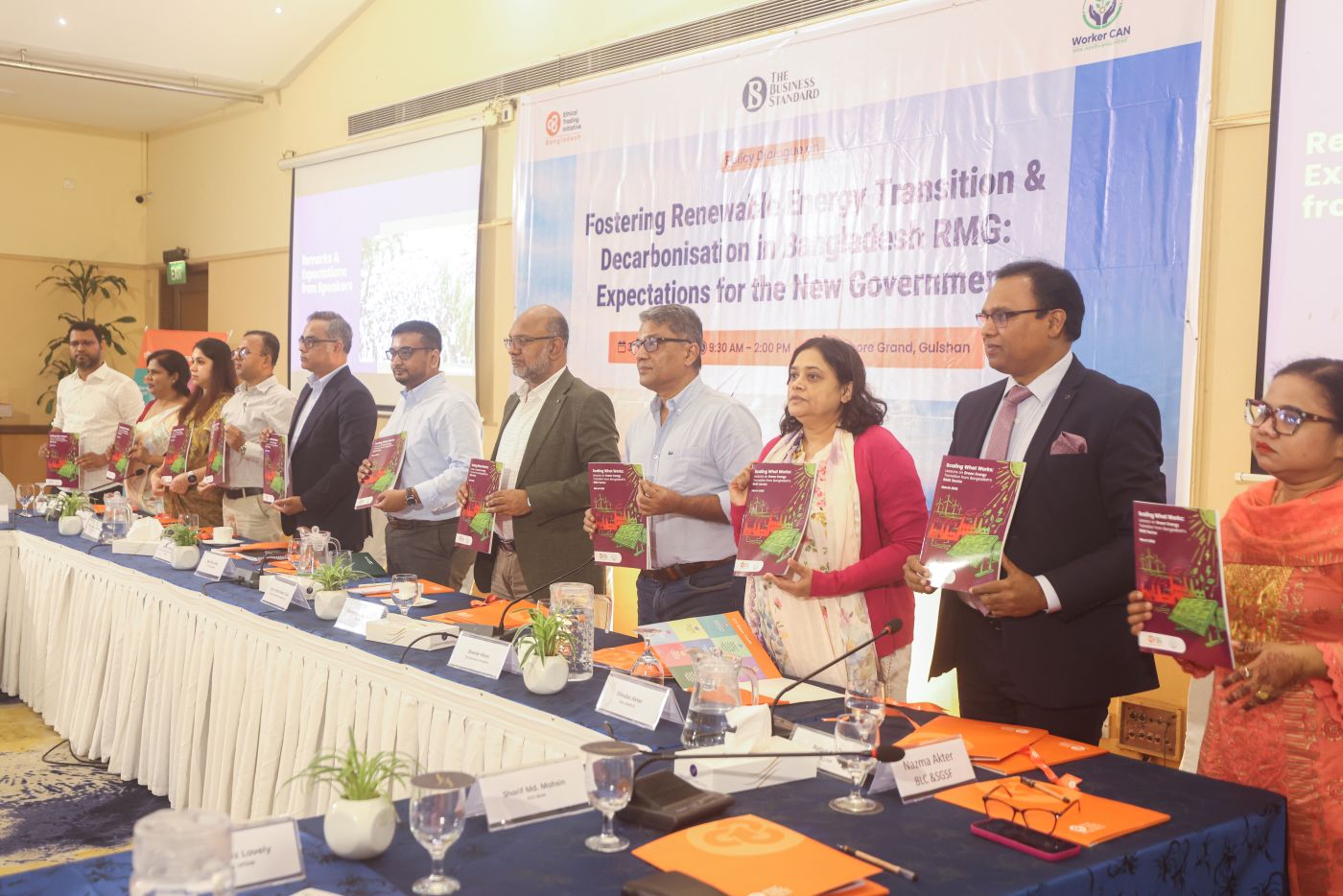
On 31st March 2026, stakeholders at a multistakeholder policy dialogue in Dhaka called for stronger and more practical government support to accelerate renewable energy transition and decarbonisation in Bangladesh’s ready-made garment (RMG) sector. Speakers stressed that the issue is increasingly tied to the industry’s long-term competitiveness, energy security, and future market access.


This event was jointly organised by Ethical Trading Initiative (ETI) Bangladesh, The Business Standard and Worker-Led Climate Action Network (Worker CAN) – an alliance of youth and women representatives of trade union federations in the RMG sector.
Industry representation comprised of the Department of Environment - Ministry of Environment, Forestry & Climate Change, the Department of Labour – Ministry of Labour & Employment, Bangladesh Garment Manufacturers and Exporters Association (BGMEA), the Bangladesh Knitwear Manufacturers and Exporters Association (BKMEA), Bangladesh Sustainable and Renewable Energy Association (BSREA), manufacturers, global apparels brands, trade union federations, commercial banks, labour right organisations, academia, and civil society organisations.
A recurring message from the event was that the current energy context demands a policy shift, with speakers noting, “The era of cheap energy is over.” Participants said this reality must now be reflected in government planning, industrial policy, and public support systems for transition.
Stakeholders called for stronger government-led advisory and implementation support so that factories can translate broader policy ambitions into workable transition plans.
Recommendations included simpler approval processes for renewable energy projects, a one-stop service for utility and power-related approvals, clearer net metering and smart-grid pathways, and more workable systems for renewable power purchasing. Speakers also called for stronger institutional facilitation, including a more active and autonomous role for regulatory bodies such as SREDA in supporting industrial decarbonisation and renewable energy uptake.
Finance was another major issue raised in the discussion. Stakeholders recommended stronger banking support through concessional lending, better refinancing facilities, a gradual shift toward pre-financing options, risk-sharing tools, and a wider range of green finance products. They also said information on green funds needs to be easier to access and better communicated, particularly so that smaller factories can identify available schemes, understand eligibility requirements, and secure financing for transition.
Eng. Imran Kader Turjo, Director at BKMEA, noted that if the policy and regulatory environment were more supportive, manufacturers would not have to spend so heavily on fossil-fuel-based imported energy to keep factories running amid rising energy insecurity.
He added, “Why do we spend so much to import energy? We do not want to do that, but the Government needs to motivate us to shift away from fossil-fuel based import reliance.”
Land scarcity was emphasised as a major barrier to implementation, alongside rooftop constraints, grid and infrastructure limitations, and, the lack of central or shared renewable energy solutions for industry. Speakers said this is an area where government support is needed, particularly to improve land access for renewable energy in ways that do not undermine livelihoods or use up arable land. Suggestions raised during the event included solar zones, shared renewable energy hubs, and other common solutions for factories where on-site space is limited.
Kamran Sadique, Chairman, Standing Committee on RSC & Co-Chair, Standing Committee on Decarbonisation, BGMEA noted that if land and enabling infrastructure are made more accessible through public support, manufacturers would be more willing to invest in renewable energy.
Government representatives and other participants underlined the need for stronger research, knowledge, and evidence-based planning to support transition.
A major point raised at the event was the government’s responsibility to ensure that the transition is inclusive and fair. Participants stressed that workers should be recognised not only as those affected by the transition, but as rightsholders and active contributors to industrial change, especially for energy efficiency. They called for stronger government attention to worker participation, skills development, job security, gender inclusion, and wider just transition concerns.
“At present, green transition is important. This transition will not only bring challenges but also opportunities for workers. We want this transition to be fair for workers who are the lifeblood of this industry,” adds Shehely Afroz Lovely, Convenor of Worker CAN.
The discussion further highlighted concerns around brand accountability, noting that rising decarbonisation expectations are not always matched by long-term commitments, co-investment, or supportive purchasing practices. Speakers stressed that the costs of transition should not fall on suppliers alone, and called for fairer risk-sharing, with government playing a more enabling and supportive role.
A keynote presented by ETI Bangladesh shared policy recommendations collated through consultations with key industry actors. It called for a more renewable energy-friendly and inclusive policy framework for the RMG sector, backed by stronger coordination across relevant ministries and agencies, wider stakeholder consultation, and greater transparency and accountability in energy governance. The recommendations further highlighted the need for stronger public institutions and service delivery, improved energy data management and monitoring, more accessible green finance and risk-sharing mechanisms, shared and cluster-based “zonal” renewable energy solutions where factory-level implementation is constrained, and stronger worker inclusion through an industry-specific just transition approach.
Closing the event, Abil Bin Amin, Executive Director of ETI Bangladesh, stressed the need for a practical pathway for renewable energy transition in Bangladesh’s RMG sector, supported by better alignment between public policy and private investment and more structured collaboration across the value chain through meaningful stakeholder engagement.


