
Bangladesh's energy sector stands at a critical crossroads. Whilst electricity access has expanded dramatically, with near-universal coverage and per capita consumption rising sharply, this progress has come at enormous cost: billions in capacity payments to private power plants, substantial losses for the Bangladesh Power Development Board (BPDB), and a heavy annual burden from imported fossil fuels that strains foreign reserves and threatens energy security. Reliance on fossil fuels has nearly doubled the country's CO₂ emissions in recent years and is a major contributor to severe air pollution and environmental degradation affecting every citizen.
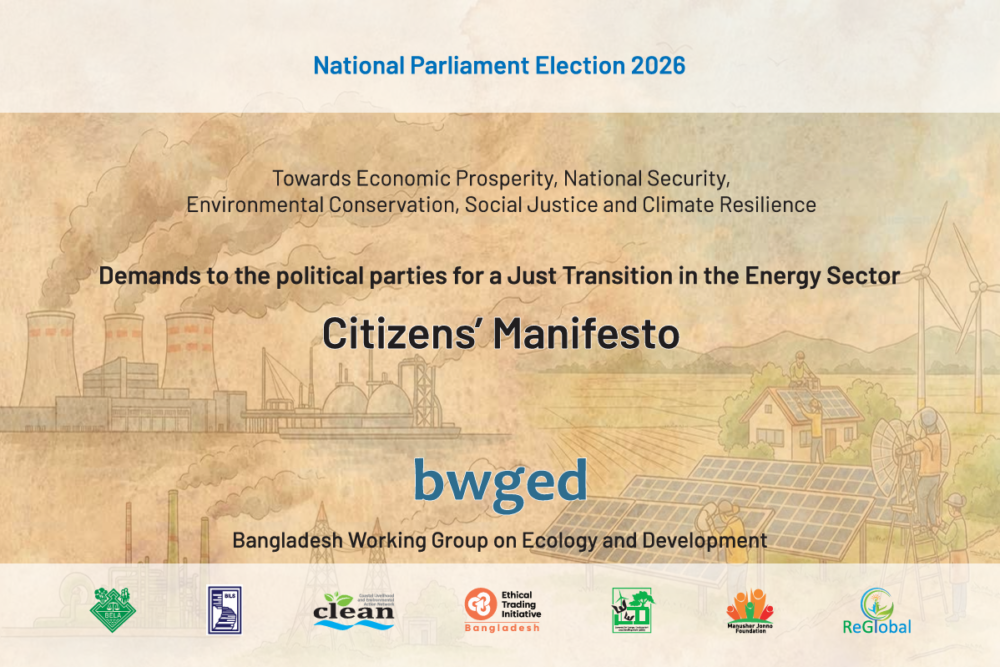
In November 2025, the Bangladesh Working Group on Ecology & Development (BWGED), in collaboration with seven civil society partners including ETI Bangladesh, CLEAN, BELA, BILS, LEED, Manusher Jonno Foundation, and Re Global, launched the Citizens’ Manifesto entitled “13th National Parliament Election 2026: Demands to the Political Parties for a Just Transition in the Energy Sector”.
This 13-point document confronts the intertwined economic, environmental, and equity crises head-on. It calls for a just transition to decarbonisation that places inclusive processes at its heart, ensuring genuine consultation and participation by communities, workers, women, indigenous groups, farmers, fishers, and other marginalised stakeholders so that the shift to cleaner energy leaves no one behind.
The manifesto sets out urgent demands for the government that emerges from the 2026 national elections. It advocates an equitable and inclusive move towards renewable energy, with strong emphasis on decarbonisation, improved energy security, and protection of vulnerable populations.
Key concerns highlighted include:
- Heavy dependence on imported fossil fuels, resulting in massive financial strain through capacity payments, BPDB losses, and high annual import costs;
- Rising emissions and worsening air pollution, with fossil fuel plants playing a significant role in the country’s poor global environmental rankings;
- Serious human and social costs, including conflicts over land acquisition, labour issues, and livelihood impacts at projects such as Banshkhali, Payra, and Rampal.
The manifesto insists on meaningful involvement of affected groups in planning and decision-making to deliver green jobs, fair labour standards, an end to forced land acquisition, and protection of vulnerable livelihoods.
Through consultations facilitated by BWGED and its partners, the 13 demands have been presented to major political parties, including the BNP, NCP, Rasthra Sangskar Andolon, Ganosamhati Andolon, BASOD, JASOD, and CPB. The aim is to influence their election manifestos and secure enduring commitments to:
- Rapid expansion of renewable energy
- Reduced dependence on fossil fuels
- Greater transparency and anti-corruption measures
- Strengthened energy sovereignty
This manifesto represents a unified call from civil society for a sustainable, fair, and resilient energy future for Bangladesh.
Reliance on fossil fuels has nearly doubled the country's CO₂ emissions in recent years and is a major contributor to severe air pollution and environmental degradation affecting every citizen.
Bangladesh's energy sector stands at a critical crossroads. Whilst electricity access has expanded dramatically, with near-universal coverage and per capita consumption rising sharply, this progress has come at enormous cost: billions in capacity payments to private power plants, substantial losses for the Bangladesh Power Development Board (BPDB), and a heavy annual burden from imported fossil fuels that strains foreign reserves and threatens energy security. Reliance on fossil fuels has nearly doubled the country's CO₂ emissions in recent years and is a major contributor to severe air pollution and environmental degradation affecting every citizen.
In November 2025, the Bangladesh Working Group on Ecology & Development (BWGED), in collaboration with seven civil society partners including ETI Bangladesh, CLEAN, BELA, BILS, LEED, Manusher Jonno Foundation, and Re Global, launched the Citizens’ Manifesto entitled “13th National Parliament Election 2026: Demands to the Political Parties for a Just Transition in the Energy Sector”.
This 13-point document confronts the intertwined economic, environmental, and equity crises head-on. It calls for a just transition to decarbonisation that places inclusive processes at its heart, ensuring genuine consultation and participation by communities, workers, women, indigenous groups, farmers, fishers, and other marginalised stakeholders so that the shift to cleaner energy leaves no one behind.
The manifesto sets out urgent demands for the government that emerges from the 2026 national elections. It advocates an equitable and inclusive move towards renewable energy, with strong emphasis on decarbonisation, improved energy security, and protection of vulnerable populations.
Key concerns highlighted include:
- Heavy dependence on imported fossil fuels, resulting in massive financial strain through capacity payments, BPDB losses, and high annual import costs;
- Rising emissions and worsening air pollution, with fossil fuel plants playing a significant role in the country’s poor global environmental rankings;
- Serious human and social costs, including conflicts over land acquisition, labour issues, and livelihood impacts at projects such as Banshkhali, Payra, and Rampal.
The manifesto insists on meaningful involvement of affected groups in planning and decision-making to deliver green jobs, fair labour standards, an end to forced land acquisition, and protection of vulnerable livelihoods.
Through consultations facilitated by BWGED and its partners, the 13 demands have been presented to major political parties, including the BNP, NCP, Rasthra Sangskar Andolon, Ganosamhati Andolon, BASOD, JASOD, and CPB. The aim is to influence their election manifestos and secure enduring commitments to:
- Rapid expansion of renewable energy
- Reduced dependence on fossil fuels
- Greater transparency and anti-corruption measures
- Strengthened energy sovereignty
This manifesto represents a unified call from civil society for a sustainable, fair, and resilient energy future for Bangladesh.