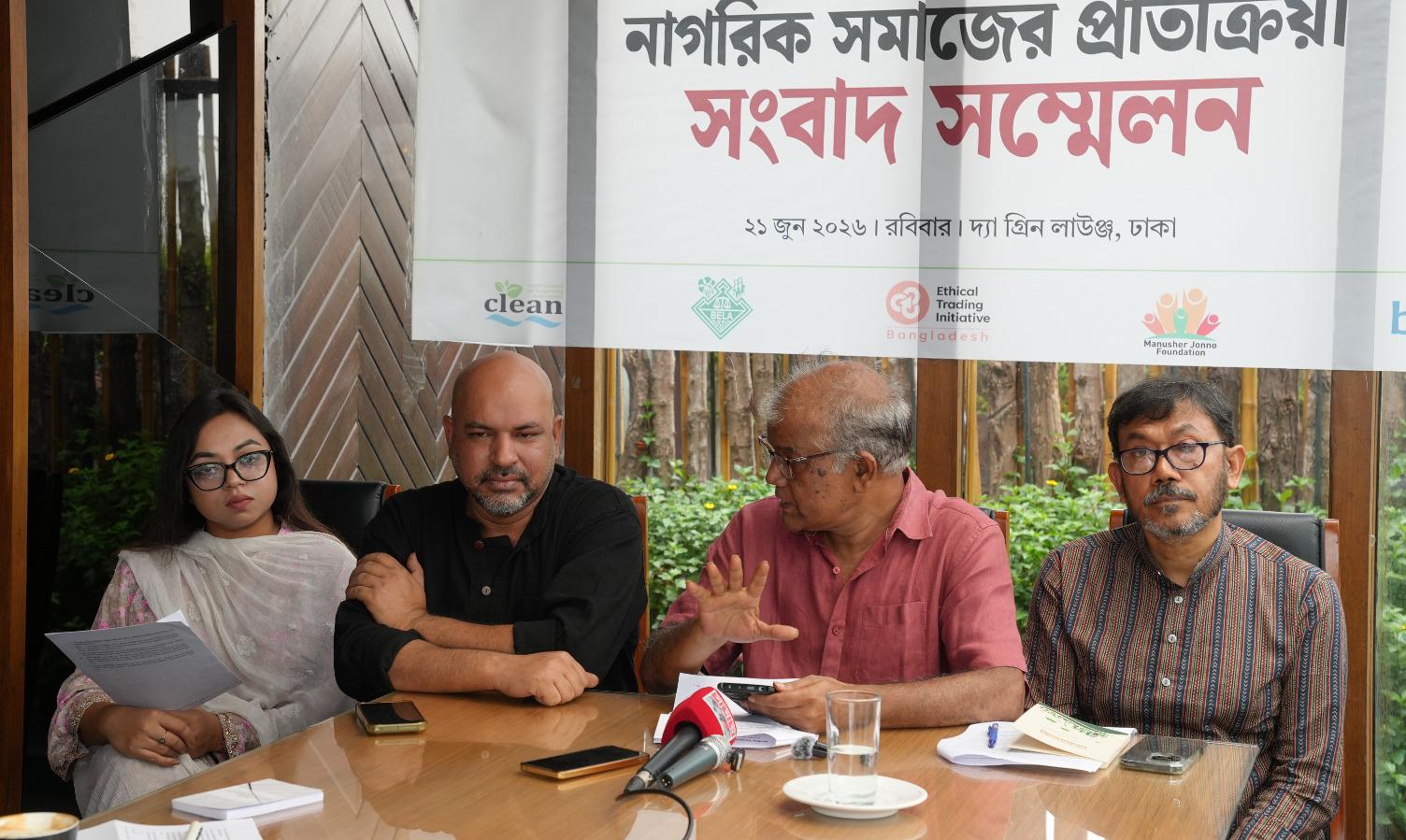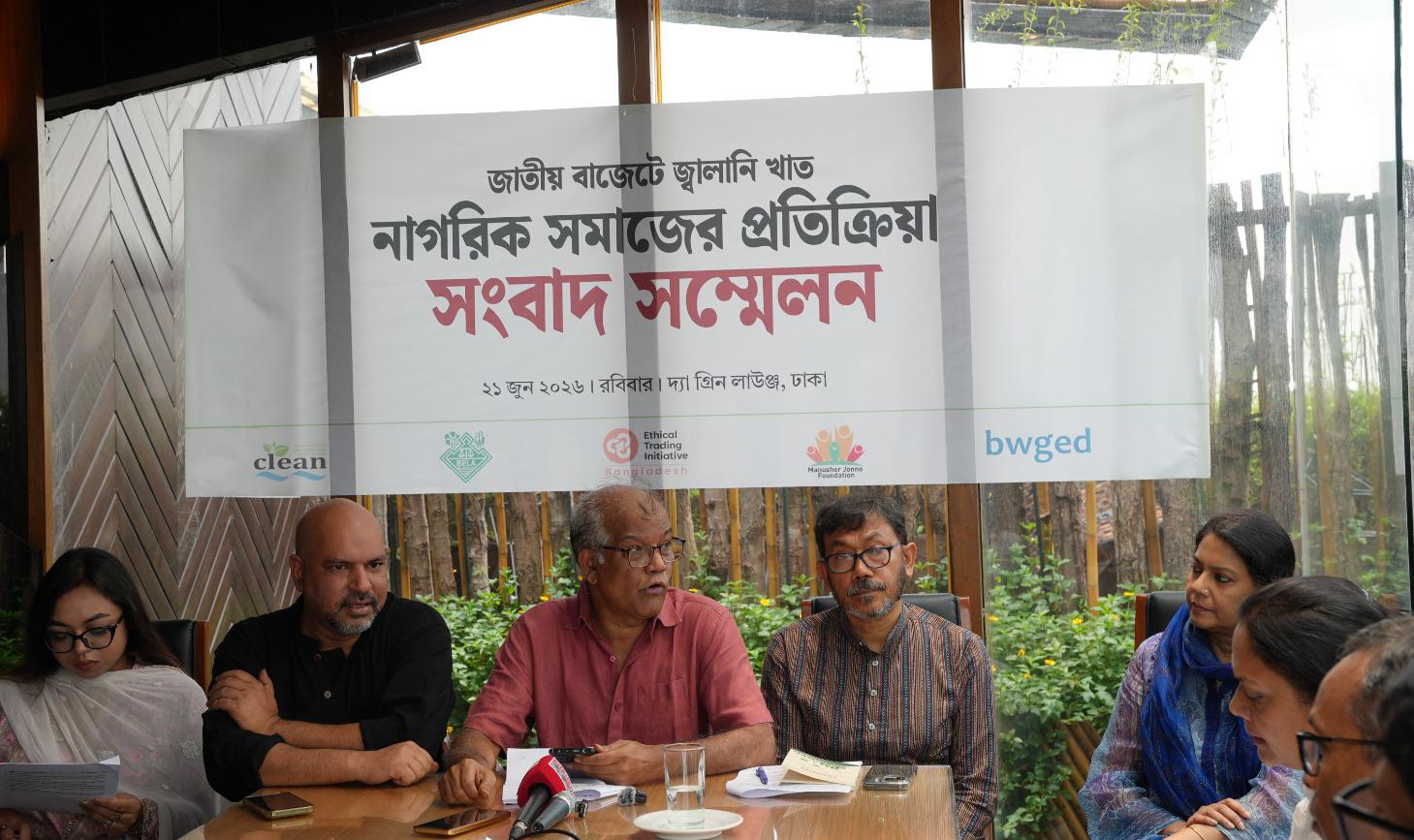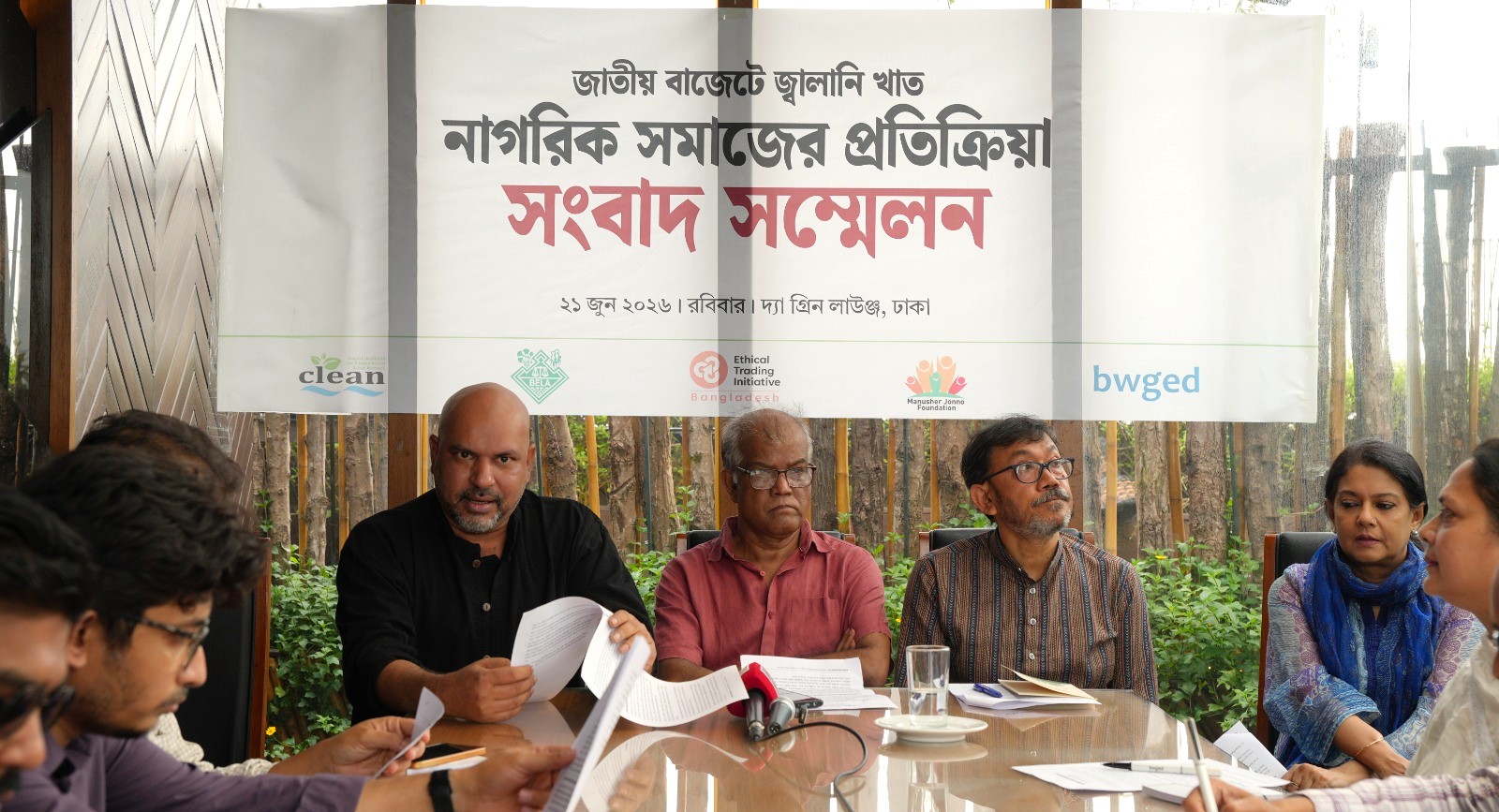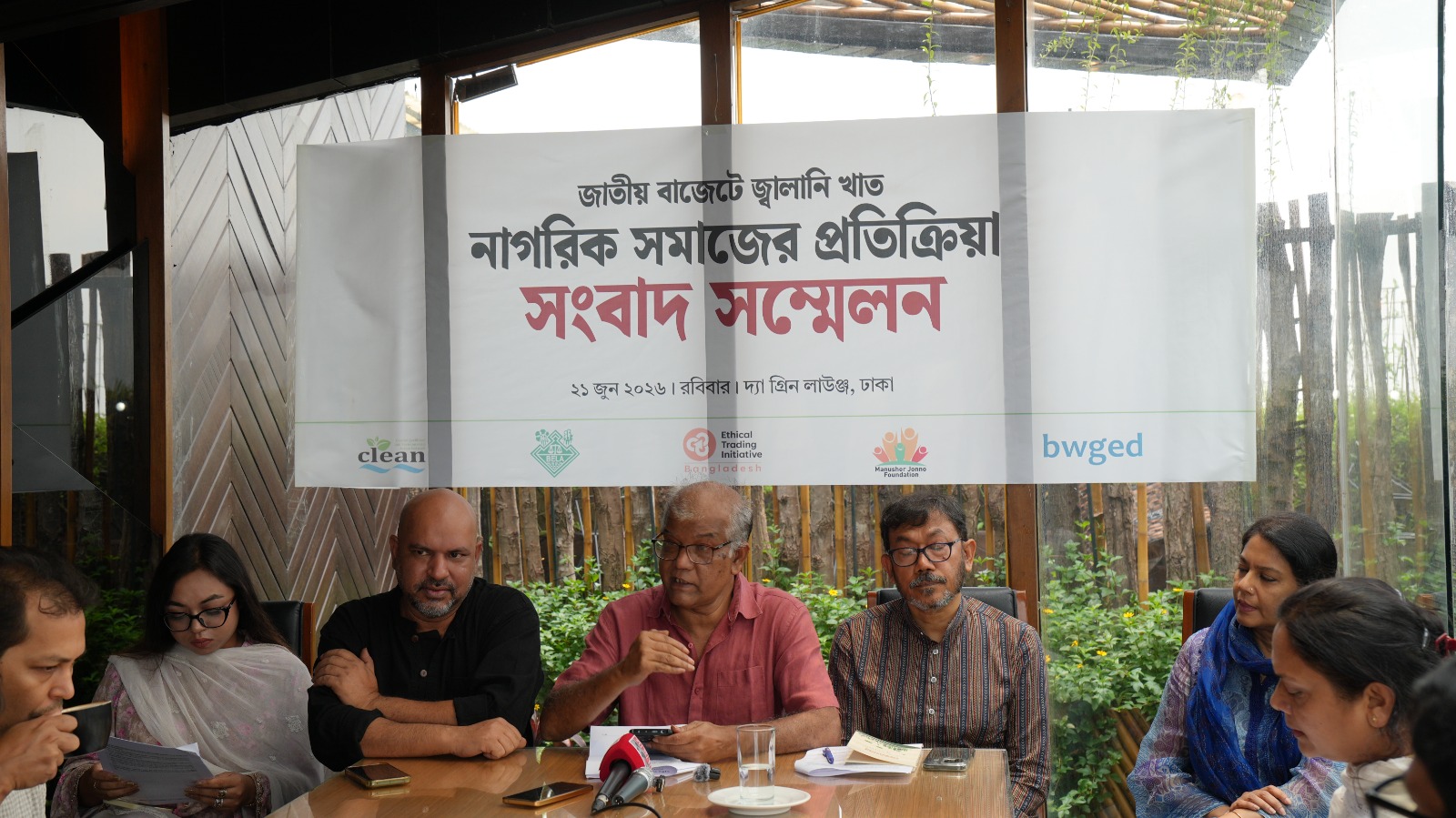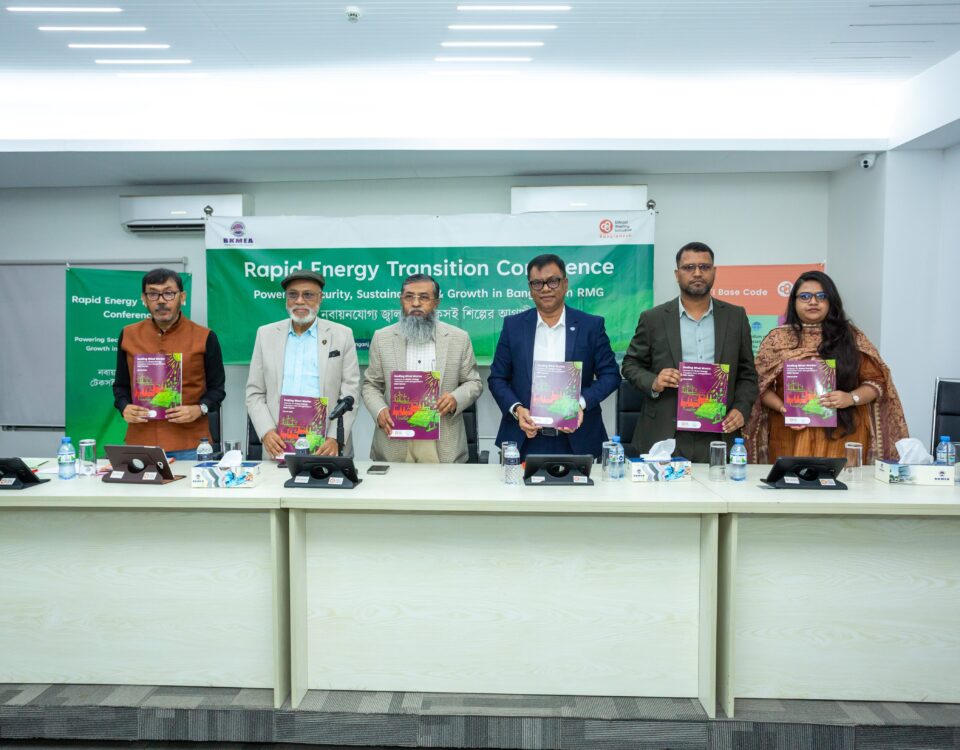
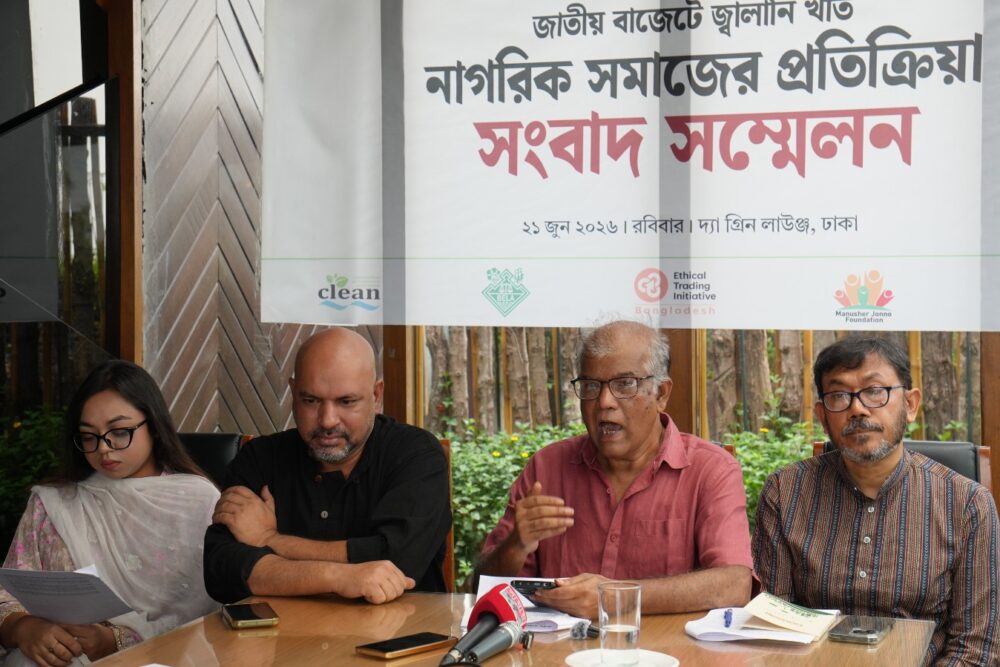
On 21 June 2026, civil society actors at a press conference in Dhaka urged the Government of Bangladesh to turn its renewable energy commitments into real budgetary action, warning that Bangladesh’s energy budget still remains overwhelmingly tilted towards fossil fuels.
The call was made at a press conference titled “Energy Sector in the National Budget: Civil Society Perspectives". The event was jointly organised by the Coastal Livelihood and Environmental Action Network (CLEAN), Bangladesh Working Group on Ecology and Development (BWGED), Ethical Trading Initiative (ETI) Bangladesh, Bangladesh Environmental Lawyers Association (BELA), and Manusher Jonno Foundation (MJF).
The press conference was addressed by Hasan Mehedi, Chief Executive at CLEAN; Monower Mostafa, Networking Advisor at CLEAN; Syeda Rizwana Hasan, Chief Executive at BELA; Farah Anzum, Global Climate Activist; and Munir Uddin Shamim, Director at ETI Bangladesh.
Speakers welcomed the government’s decision in the FY2026–27 budget to exempt import duties, value-added tax and advance income tax on renewable energy equipment, particularly solar technologies. They said this could help reduce rooftop solar installation costs by around 30–37%, making clean energy more affordable for households, businesses and farmers.
However, they also warned that the overall direction of the energy budget still does not match the country’s renewable energy ambition. Nearly 98% of the energy budget continues to favour fossil fuel-based projects, while renewable energy receives only a marginal share.
Delivering the keynote, Monower Mostafa of CLEAN emphasised that the faster Bangladesh can shift to renewables, the quicker the nation can move towards a resilient power and energy sector.
Hasan Mehedi, Chief Executive of CLEAN and Member Secretary of BWGED, said Bangladesh needs at least Tk 21,750 crore every year to achieve its renewable energy targets by 2030. This includes a minimum public investment of Tk 6,750 crore annually.
Although Tk 17,193 crore has been allocated for the power and energy sector in the FY2026–27 budget, only Tk 379.24 crore, or 2.2%, has been earmarked for renewable energy.
Speakers raised concern over the National Board of Revenue’s Statutory Regulatory Order issued on 8 June 2026, saying it could prevent millions of residential consumers, farmers and small entrepreneurs from accessing the proposed tax exemptions. Speakers noted that if incentives are designed mainly for large VAT-registered companies and corporate developers, the clean energy transition will remain limited and unequal.
The continuation of fiscal support for fossil fuel-based energy was also criticised. Speakers pointed to tax exemptions for LNG imports, extended incentives for coal imports and continued investment in fossil fuel infrastructure, including coal mine expansion, refineries and coal jetties.
Syeda Rizwana Hasan of BELA said renewable energy targets must be backed by clear budget allocations and effective implementation. Without that, policy ambition will remain disconnected from the practical needs of people, communities and businesses.
Munir Uddin Shamim, Director of ETI Bangladesh, commended the government for its pro-renewable tax exemptions while raising concern regarding the implementation of the proposed national budget.
“A green energy transition cannot be achieved while keeping inequality in place. To reduce carbon emissions, the government must provide effective incentives. At the same time, proper coordination between budgetary measures and policy direction is needed to raise the 2027 renewable energy target and respond to the demands of global supply chains,” he said.
He further noted that Bangladesh’s growth and inflation management goals cannot be separated from industrial energy security. For priority export-orientated sectors such as RMG, attracting private sector investment in renewable energy and decarbonisation will require a stronger enabling environment, including concessional facilities, fiscal incentives, simplified procedures and clearer coordination across government agencies. This would help factories meet emerging EU regulations and global buyer expectations while strengthening the business case for cleaner energy.
Farah Anzum, Global Climate Activist, further stressed that upcoming policy frameworks must be aligned with the budget. Referring to the continued fossil fuel-heavy direction of public allocation, she raised the question of whether the government is serious about phasing out fossil fuels.
Key recommendations from the press conference included:
- Revise the restrictive NBR SRO issued on 8 June 2026 and remove all duties and taxes on solar power equipment for at least the next 10 years, ensuring that renewable energy tax benefits are accessible to households, farmers, small entrepreneurs, community-level users, businesses and industries, not only larger corporate actors.
- Strengthen public investment and concessional finance for renewable energy, including the establishment of a Tk 25,000 crore Renewable Energy Fund, at least Tk 6,750 crore in annual government allocation, and loans through scheduled commercial banks capped at a maximum interest rate of 5%, as part of the estimated Tk 21,750 crore required each year to achieve Bangladesh’s 2030 renewable energy target.
- Make renewable energy adoption more accessible and inclusive by introducing direct subsidies for residential and agricultural solar systems, including at least Tk 2,000 per kilowatt, and an additional 10% incentive for women- and Indigenous-led renewable energy projects.
- Enable wider clean energy generation and grid stability by operationalising Corporate Power Purchase Agreement guidelines, introducing competitive wheeling charges, and making battery energy storage systems mandatory for new utility-scale solar projects, with storage capacity equivalent to at least 20% of project capacity.
- Reduce fiscal support for fossil fuels, including tax exemptions and incentives linked to LNG, coal imports, coal mine expansion and fossil fuel infrastructure.
- Introduce targeted incentives and concessional facilities for priority export-oriented industries, particularly RMG, to decarbonise. This would help factories view renewable energy not only as a compliance requirement but also as a business case for reducing energy costs, improving resilience and strengthening competitiveness in global supply chains.
- Create an enabling policy and financing environment for priority export-oriented industries, particularly RMG, to attract large-scale private sector investment in decarbonisation and renewable energy. As the government works towards GDP growth and inflation reduction targets, targeted concessional facilities, fiscal incentives, simplified approvals and clear policy signals would help factories align with EU regulations, buyer requirements and global supply chain expectations.
- Expand renewable energy skills training through relevant government departments, including the Department of Youth Development, Department of Women Affairs, Department of Cooperatives and the Ministry of Labour and Employment, so that the transition can create decent green jobs.
- Improve coordination between budget, policy and implementation, including stronger inter-agency and inter-ministerial collaboration among the Ministry of Finance, Ministry of Power, Energy and Mineral Resources, National Board of Revenue, Ministry of Environment, Forest and Climate Change, Ministry of Labour and Employment and other relevant agencies so that renewable energy commitments are implemented effectively.
The press conference concluded with a clear message: Bangladesh has taken some encouraging steps, but the national budget must now move beyond fossil fuel dependence and create the necessary enabling conditions for a more affordable, inclusive and renewable energy future.