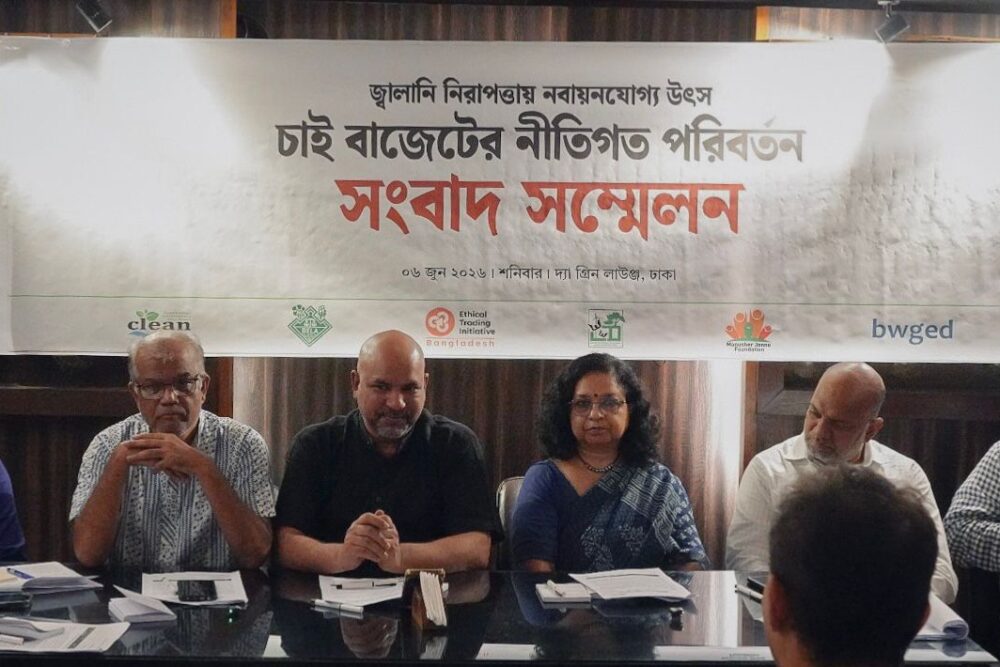
On 6 June 2026, civil society actors at a press conference in Dhaka called for the Government of Bangladesh to prioritise renewable energy in the upcoming national budget through clear tax reform, especially renewable energy-friendly fiscal incentives, dedicated green financing and stronger policy support.
The call was made at a press conference jointly organised by the Coastal Livelihood and Environmental Action Network (CLEAN) and the Bangladesh Working Group on Ecology and Development (BWGED), alongside Ethical Trading Initiative (ETI) Bangladesh, the Bangladesh Environmental Lawyers Association (BELA), Lawyers for Energy, Environment and Development (LEED), and Manusher Jonno Foundation.
The press conference was addressed by Hasan Mehedi, Chief Executive at CLEAN; Monower Mostafa, Networking Advisor at CLEAN; Mostofa Al Mahmud, President of the Bangladesh Sustainable and Renewable Energy Association (BSREA); Banasree Mitra Neogi, Director at Manusher Jonno Foundation; Advocate Shimonuzzaman, Research Director at LEED and, Munir Uddin Shamim, Director at ETI Bangladesh.
Speakers welcomed the government’s recent policy signals on renewable energy as a positive step. However, they stressed that these signals now need to be reflected in the national budget. Without practical fiscal support, affordable finance and tax reform, renewable energy targets may remain difficult to implement on the ground.
The discussion highlighted that the issue is not a lack of potential, but a lack of enabling support. High taxes on renewable energy equipment, limited access to affordable finance, and slow implementation of existing policy commitments are making it harder for households, farmers, small businesses and industries to shift to cleaner energy. The keynote presented at the event shared that Bangladesh currently has around 1,679 MW of installed renewable energy capacity (including hydropower, solar and wind), against an estimated solar and wind potential of nearly 132,000 MW (according to the US National Renewable Energy Laboratory). That being said, high taxes, weak financing mechanisms and policy barriers continue to slow down investment and uptake.
Monower Mostofa, Networking Advisor at CLEAN remarked in his keynote that, “Renewables should be viewed as essential goods at least in the immediate short-term to ensure Bangladesh’s energy security.”
Speakers also noted that renewable energy is no longer only an environmental issue. It is closely linked to energy security, industrial resilience, export competitiveness and job security. For Bangladesh’s export-oriented sectors, including ready-made garments, rising energy costs, fossil fuel import dependence and uncertainty in energy supply are already creating significant pressure. A renewable energy-friendly budget can help industries move towards cleaner and more secure energy while protecting competitiveness, jobs and long-term resilience.
Speaking on behalf of ETI Bangladesh, Munir Uddin Shamim focused on the urgency of industrial decarbonisation in export-oriented industries. Drawing lessons from global energy crises since the Russia-Ukraine war in 2022, he noted that energy systems do not stabilise overnight even when conflicts ease. For Bangladesh, continued dependence on imported fossil fuels means that export-oriented industries remain exposed to repeated cost increases and supply disruptions.
He also emphasised that the government’s recent communication and policy signals on renewable energy are encouraging. However, these commitments must now be translated into the upcoming national budget. He noted that political commitments on renewable energy and green transition, including those reflected in election manifestos, need to move from promises to practical fiscal measures. The resilience of export-oriented industries will depend on how quickly Bangladesh can make its wider power and energy infrastructure cleaner, more reliable and less dependent on imported fossil fuels. The proposed deferral of the nation’s LDC-status graduation gives Bangladesh more time, but that time must be used to prepare. For sectors such as RMG, this means reducing energy vulnerability now and accelerating the transition to renewable energy before competitiveness pressures deepen even further.
Major recommendations from the press conference included:
- Reduce taxes on renewable energy equipment
Reduce the total tax burden on all renewable energy equipment to a symbolic 1% for the next 10 years, so that solar and other clean energy solutions become more affordable for households, farmers, small entrepreneurs and industries. - Create a dedicated renewable energy financing mechanism
Establish a Tk 25,000 crore revolving fund under Bangladesh Bank to support renewable energy financing through commercial banks at interest rates below 5%. - Support rooftop solar and citizen-led renewable energy
Provide direct budget support for residential rooftop solar, including additional support for women-led and Indigenous community projects. - Enable private and industrial renewable energy uptake
Activate corporate power purchase agreements and introduce competitive as well as stable wheeling charges, so that industries and private investors can access renewable electricity more efficiently. - Strengthen research, data and practical planning for industrial decarbonisation
Support stronger energy data management, sector-specific research and practical renewable energy planning for export-oriented industries such as RMG. This includes assessing how much renewable energy can realistically be generated through rooftop solar while maintaining rooftop safety requirements, and identifying what policy and tax support is needed to scale renewabcan ule energy use in factories. - Consider cluster-based renewable energy solutions for RMG
Explore zonal or cluster-based renewable energy models for RMG and other export-oriented industries, where factories in specific industrial zones can work under shared renewable energy, safety and compliance frameworks. Factories that meet these standards could receive targeted incentives to scale renewable energy use more quickly. - Strengthen grid readiness and storage
Make battery energy storage systems part of new utility-scale solar projects to support grid stability and improve reliability. - Invest in green skills and jobs
Introduce national training programmes on renewable energy to build local technical capacity, reduce dependence on foreign expertise, and create green employment opportunities. - Ensure an inclusive renewable energy transition
Design budget support in a way that includes workers, small manufacturers, local entrepreneurs, women and vulnerable communities, so that the benefits of renewable energy are shared more fairly across the economy. - Include relevant ministries in budget revisions and implementation
Ensure that renewable energy-related budget revisions involve all relevant ministries and departments. For export-oriented industries such as RMG, the Ministry of Labour and Employment should be included given the links with workers, workplace safety and job security. For Indigenous peoples and diversity-related concerns, relevant institutions including the Ministry of Chittagong Hill Tracts Affairs should also be meaningfully engaged. - Ensure citizen and civil society consultation in budget decisions
Create meaningful space for citizens, workers, civil society organisations and affected communities to contribute to budgetary discussions and revisions. Without such consultation, the budget cannot fully reflect people’s needs or priorities. - Improve transparency and public access to budget information
Publish all relevant budget documents, policy updates and implementation progress reports on time. Budget information should also be made available in simple, accessible language so that citizens, workers, entrepreneurs and communities can understand how public resources are being allocated.
The press conference ended with a shared call for these civil society insights and recommendations to be reflected in the upcoming national budget, so that Bangladesh’s renewable energy commitments can move from policy signals to practical, people-centred implementation.